By John Gillies and Colleen MacDonald MacLeod
This June, the Inverness County Cares’ hard-neck garlic produced its curly central flower stalks, known as “scapes.” Once they formed their loops, the scapes were cut off at the base. This encourages the plant to send its energy back down into producing a larger garlic bulb. Garlic scapes are delicious, but when you have more than 1,000 of them, it is quite a lot of garlic scapes! Fortunately, friends were happy to take them off our hands for stir fries, pesto, pickling or perhaps warding off vampires.
By July and August, it was time to harvest the garlic bulbs. We know the garlic is ready when the bottom three or four leaves have turned brown and dry, while five or six leaves are still green. This year we were rewarded with an abundant harvest. Garlic has a different growing cycle than most other Nova Scotia crops, and because it needs well drained soil, our garlic plot is planted on a slope with full sun.
Once the current season’s crop is harvested in August, it is already time to begin preparing for next year’s garlic. The first step is to roto-till the oat straw that served as a winter cover and mulch during the growing season. The straw has been threshed and the grain seeds have been removed. As mulch, it helps retain moisture and discourage weeds. We use our Troy-Bilt Horse tiller, a true workhorse, to shred the straw and incorporate it into the soil. Many light layers of grass clippings from our neighbor’s, Hughie, Janet and Jonathan’s lawns and our own lawn are added and mixed thoroughly into the soil. Many thanks to the best neighbors. Grass clippings make wonderful green manure and best of all, contain no seeds or weeds. As the clippings decompose, they feed beneficial soil microbes and earthworms. This organic material improves the soil structure, reduces compaction, helps retain water and allows sandy or clay soils to hold nutrients more effectively. Our garlic is completely organic. No commercial fertilizers have ever been used on this plot of land.
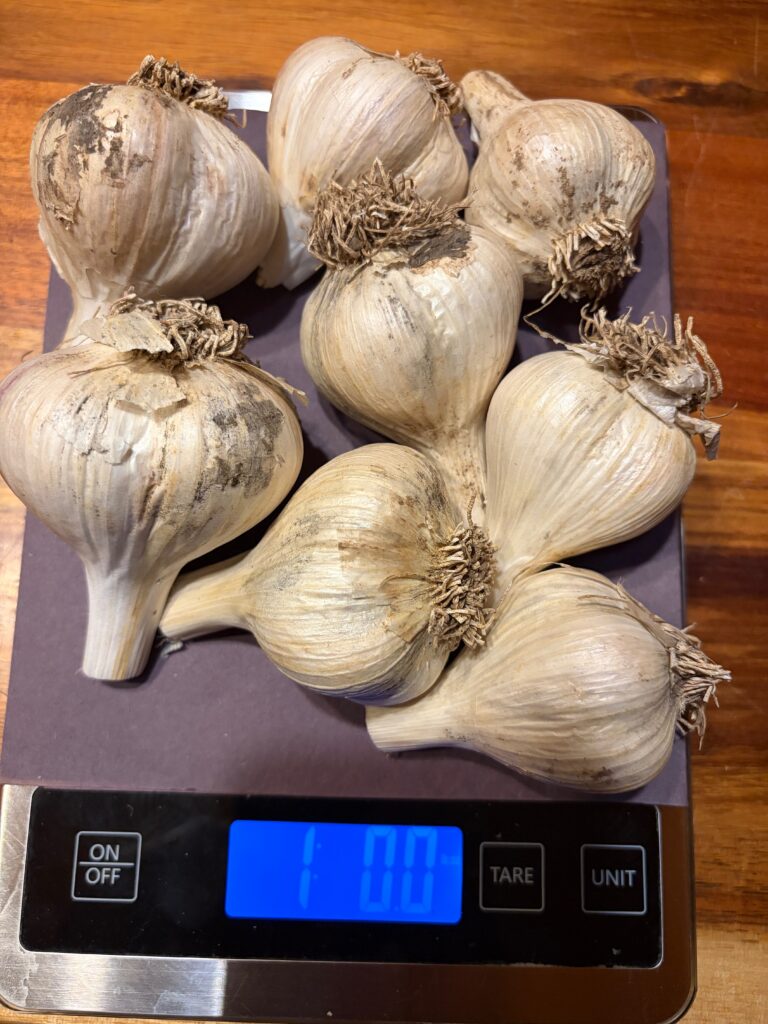
After harvesting, the hard-neck garlic bulbs are hung in our shed where there is plenty of ventilation. After three or four weeks of drying, the stalks are clipped, the roots are snipped and the bulbs are stored in ventilated baskets until they are ready for sale. The largest bulbs are saved for seed for the following year. Big cloves generally produce big bulbs, so we keep the best of the harvest for planting. We use our own garlic rather than supermarket garlic because it is not always a Canadian product, is usually soft-neck garlic and may have been treated to prevent sprouting. At present, the garlic plot is still receiving additions of grass clippings and will soon be ready for a load of composted manure from our Garden Angels. Thank you, Melissa, Troy, Justin and Alex! This will be the top layer and won’t be tilled in very deep.
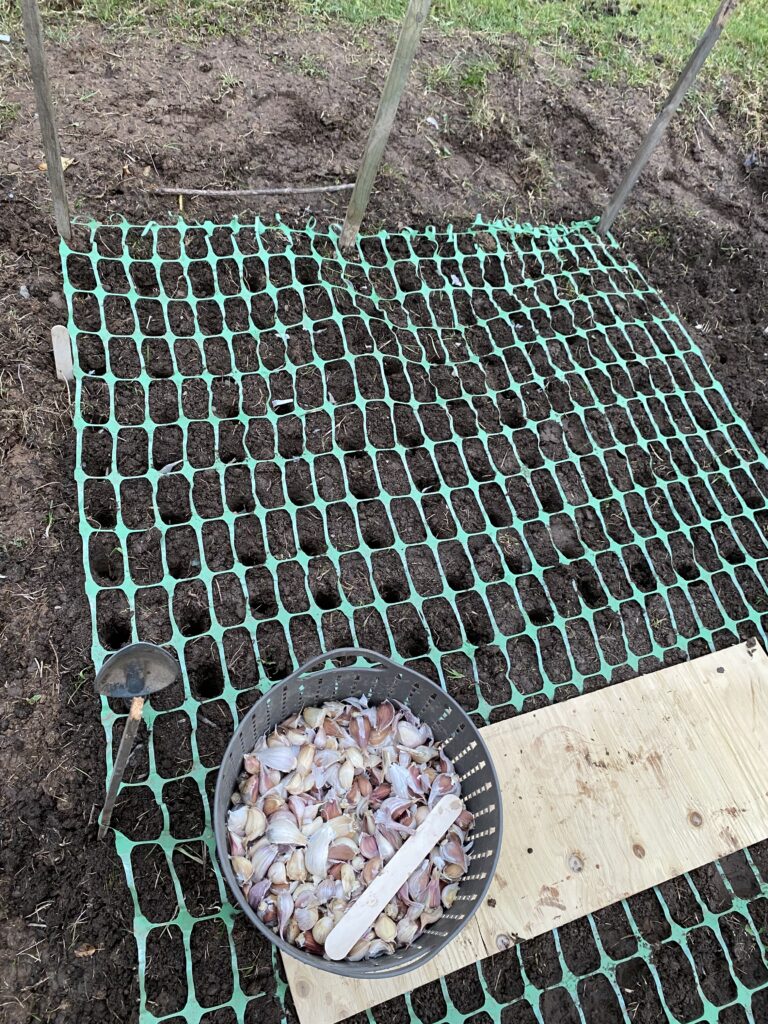
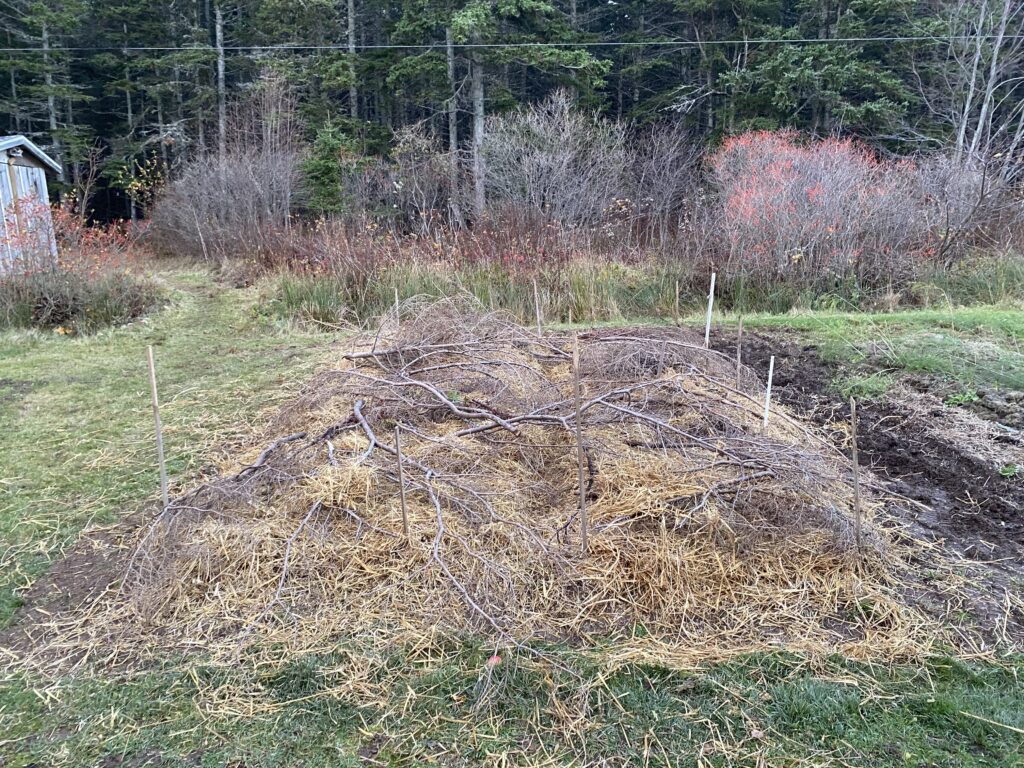
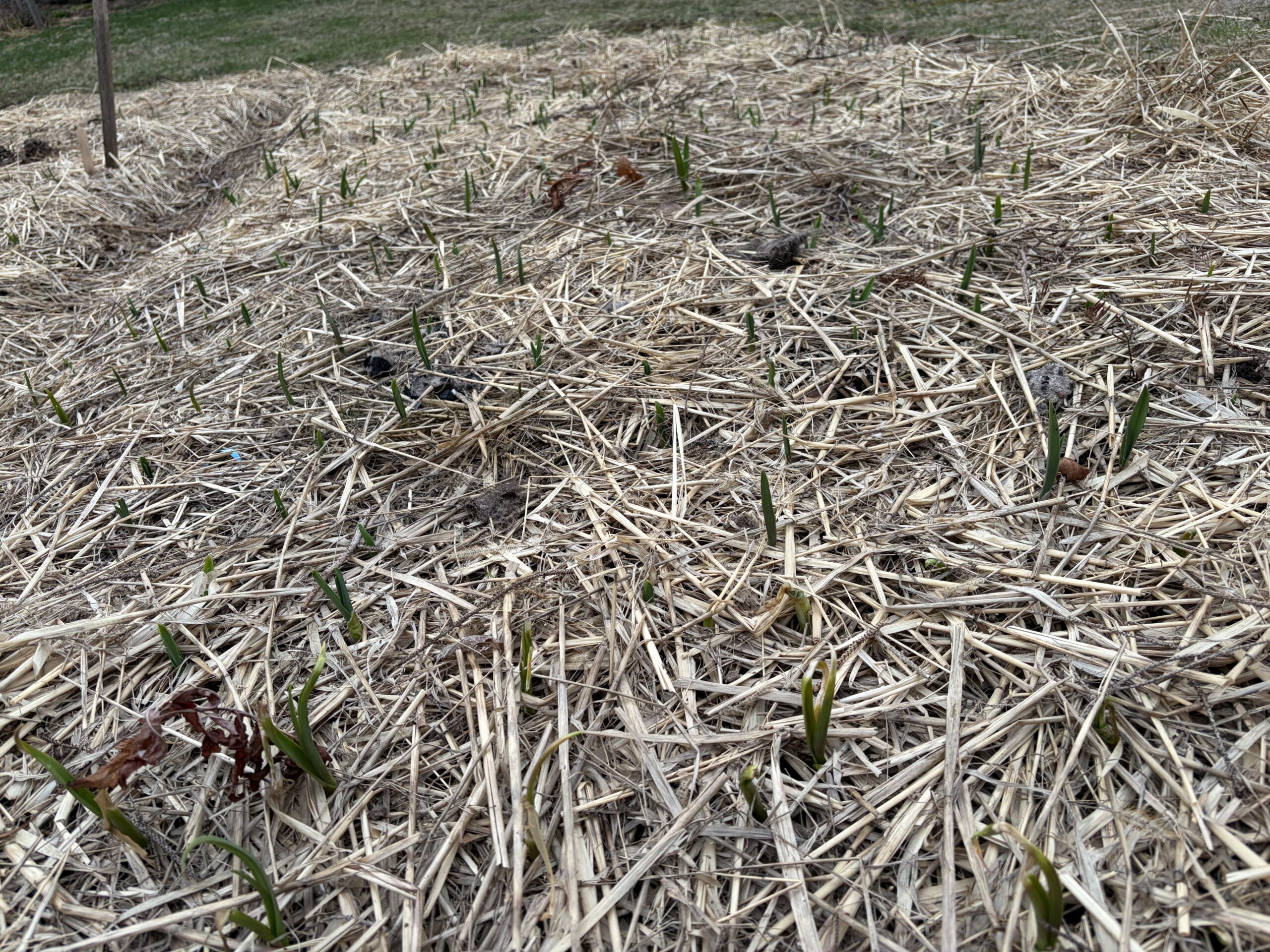
We plant our garlic cloves in late November. If planted too early, they may begin growing before winter arrives, when we would rather see that growth waiting until spring. Just before planting, we gently break the largest bulbs into individual cloves, leaving the papery skins intact. The cloves are planted about two inches deep with the pointed end facing up. They are spaced four to six inches apart, with approximately six inches between the rows. To keep everything neat and properly spaced, we use snow fence as a planting grid. It works wonderfully for making sure each clove is planted in the right spot. We also try to have the ground prepared as early as possible because by November the soil can be muddy and messy. Once the cloves are planted, they are covered with a generous layer of straw. Straw is preferable to grass clippings because it does not form a heavy mat and allows the garlic shoots to easily make their way toward the sun in the spring. The straw is then covered with spruce branches to hold it in place and catch the snow. The snow provides an additional layer of insulation against the freeze and thaw cycles we now experience each winter.
Think of garlic as a tiny natural powerhouse. When a clove is crushed or chopped, it releases compounds that are believed to offer a number of health benefits. Garlic has long been valued for its role in supporting the immune system and may help the body fight off illness. It is also associated with heart health and may help support healthy blood pressure and cholesterol levels. Garlic contains natural compounds with antioxidant and anti-inflammatory properties and has been used for centuries as part of a healthy diet.
Inverness County Cares chose garlic as a fundraiser because it produces a dependable crop, is fairly easy to care for, is popular with cooks and provides a good source of revenue for the schools for the blind in Zambia. This year we are selling our garlic for $30 a pound. Think of it as making a donation with some very healthy benefits included. All of our garlic sold out before Christmas last year and we are hoping for another successful season. Thank you to all our generous customers for your continued support. Every bulb purchased helps Inverness County Cares continue supporting schools for blind and visually impaired students in Zambia.
Inverness County Cares (ICC) is a local charitable organization, founded in 2012 and based in Inverness County, NS, Canada. ICC works in partnership with Chalice.ca, a Canadian charity, based in Bedford, Nova Scotia. Chalice provides guidance and assistance through site visits, audits and accounting. The Kawambwa Project supports two schools for blind, albino and visually impaired students in Northern Zambia. Inverness County Cares always welcomes new members. Individuals who wish to donate, can use the donate button on our website https://invernesscountycares.com When using E-transfer, please include your mailing address for CRA tax receipts and a thank you message. E-transfer address: invernesscountycares@gmail.com or send a cheque to Inverness County Cares, 5414 Route 19, Judique, NS, Canada, B0E1P0. Taxation receipts provided.
Garlic will be available after September 28th. For pre orders or orders contact Colleen MacLeod, 119 Lower Shore Road, Judique.
902-227-5425. Email: colmac27@gmail.com